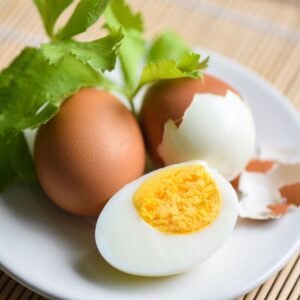
How To Make the Perfect Hard-Boiled Eggs - How To Tell When They Are Done

This in-depth guide will help you make the perfect hard-boiled eggs in a couple of steps. It's super easy once you know all the tips and tricks professionals use! So, let's get to it!
Ingredients
- 4 Large eggs, room temperature (cooks more evenly)
- Hot water, to cover the eggs
- 1/2 tsp fine salt for every egg you are boiling
Instructions
- Add the eggs to a large saucepan or pot. Make sure they are laid down in a single layer and not stacked on top of each other.
- Gently add cold water (not ice water) to the pot until it completely covers the eggs. It should reach above their tops. If you are cooking fewer than 7 eggs, you can have the water reach 1 inch over their tops. If you are cooking 7 or more eggs, the water should cover at least 2 inches above the tops of the eggs.
- Add some fine salt. This helps soften the eggshell, making it more pliable and less prone to crack when the water starts to boil. the salt simultaneously makes the egg shells easier to peel.
- Now, add the pot with water, salt, and eggs over high heat. Do not add the lid. Bring the water to a rolling boil.
- Once boiling, remove the pot from the heat, cover it with a tight-fitting lid, and leave the eggs to sit.
- As per my guidelines above, for hard-boiled eggs, you can leave them to rest for 10 minutes in the hot water. Don't leave the eggs for too long or they will overcook (form a green ring around the yolk).
- You can test the doneness of one egg before removing all of them. Personally, this is a foolproof method, but if you love to stay on the safe side of things, you can do one of the tests below.
- When you are happy with the doneness of the boiled eggs, remove them from the hot water and plunge them into ice-filled water. This immediately stops the cooking process and prevents the eggs from overcooking. It's an essential step if you are making soft or medium-boiled eggs.
Spin Test
- Spin the egg on a flat surface.
- If it wobbles, the egg isn't completely cooked inside. Instead, it's only at the medium or soft stage. You will need to continue cooking the eggs for another minute or so.
Crack Test
- This isn't ideal as you cannot continue cooking the egg once it's been cracked open. Nevertheless, it's the most accurate test.
- Peel the egg and slice it in half. See if you are happy with the doneness and remove the rest of the eggs. If they aren't fully cooked yet, don't remove the remaining eggs and leave them to cook for another minute.
Temperature Test
- You can also use an infrared thermometer to test the doneness of the egg.
- Remove the egg from the water and lay it on a piece of paper towel.
- Keep it 2 inches away from the shell. The reading should be 180°F (82°C).
Shake Test
- Use a piece of paper towel to hold the egg.
- Give it a couple of shakes to test if it feels cooked or if it feels like liquid is sloshing around on the inside.
Light Test
- Use a powerful flashlight to shine through the egg.
- If the light comes through to the other side of the shell, the egg isn't cooked to the hard-boil stage.
Nutrition
Calories: 3kcalCarbohydrates: 0.3gProtein: 6gFat: 4gSaturated Fat: 1gPolyunsaturated Fat: 1gMonounsaturated Fat: 2gTrans Fat: 0.02gCholesterol: 164mgSodium: 357mgPotassium: 61mgSugar: 0.2gVitamin A: 238IUCalcium: 25mgIron: 1mg
Tried this recipe?Let me know how it was!